USB-C Breadboard Breakouts - UBB Basic and Pro
Breadboard easily with UBB!
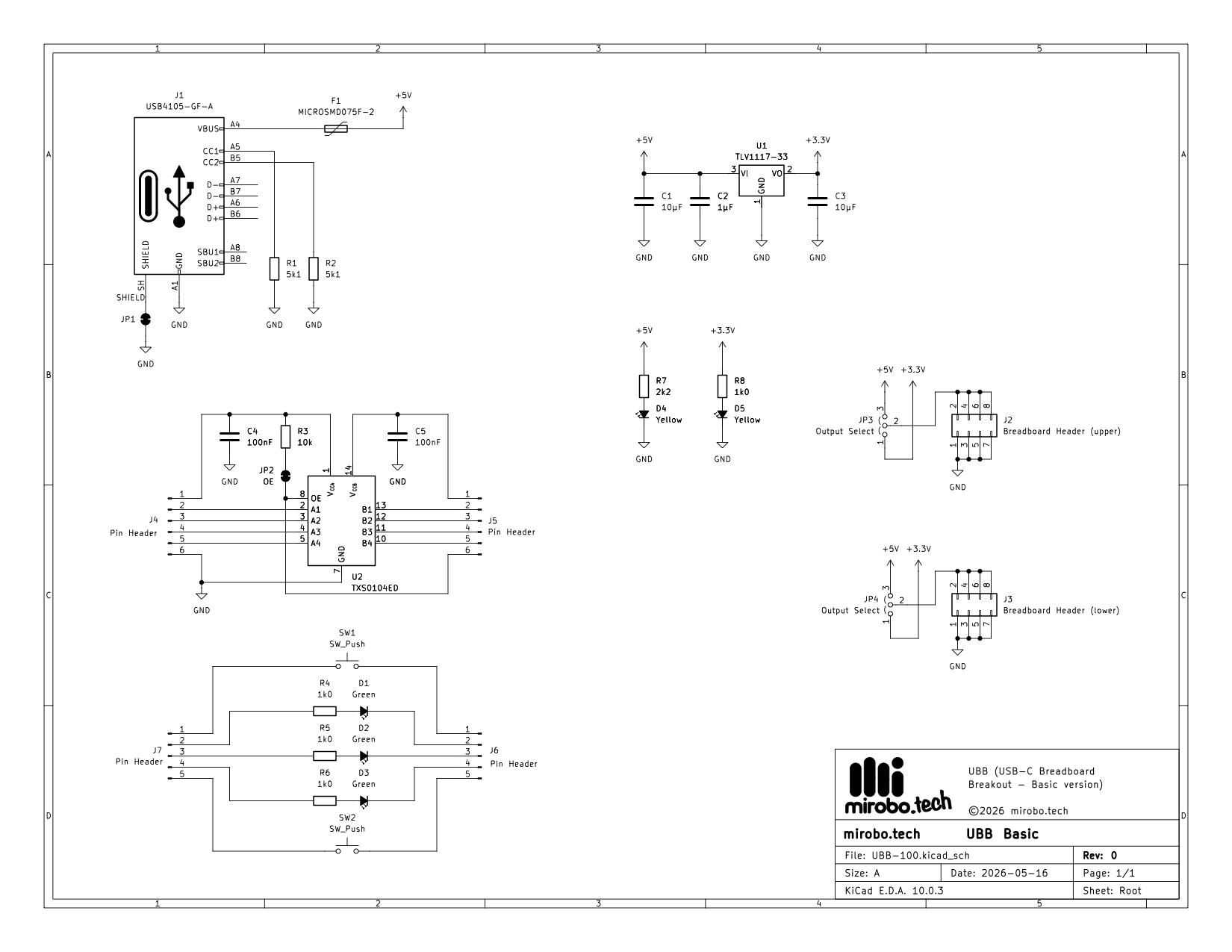
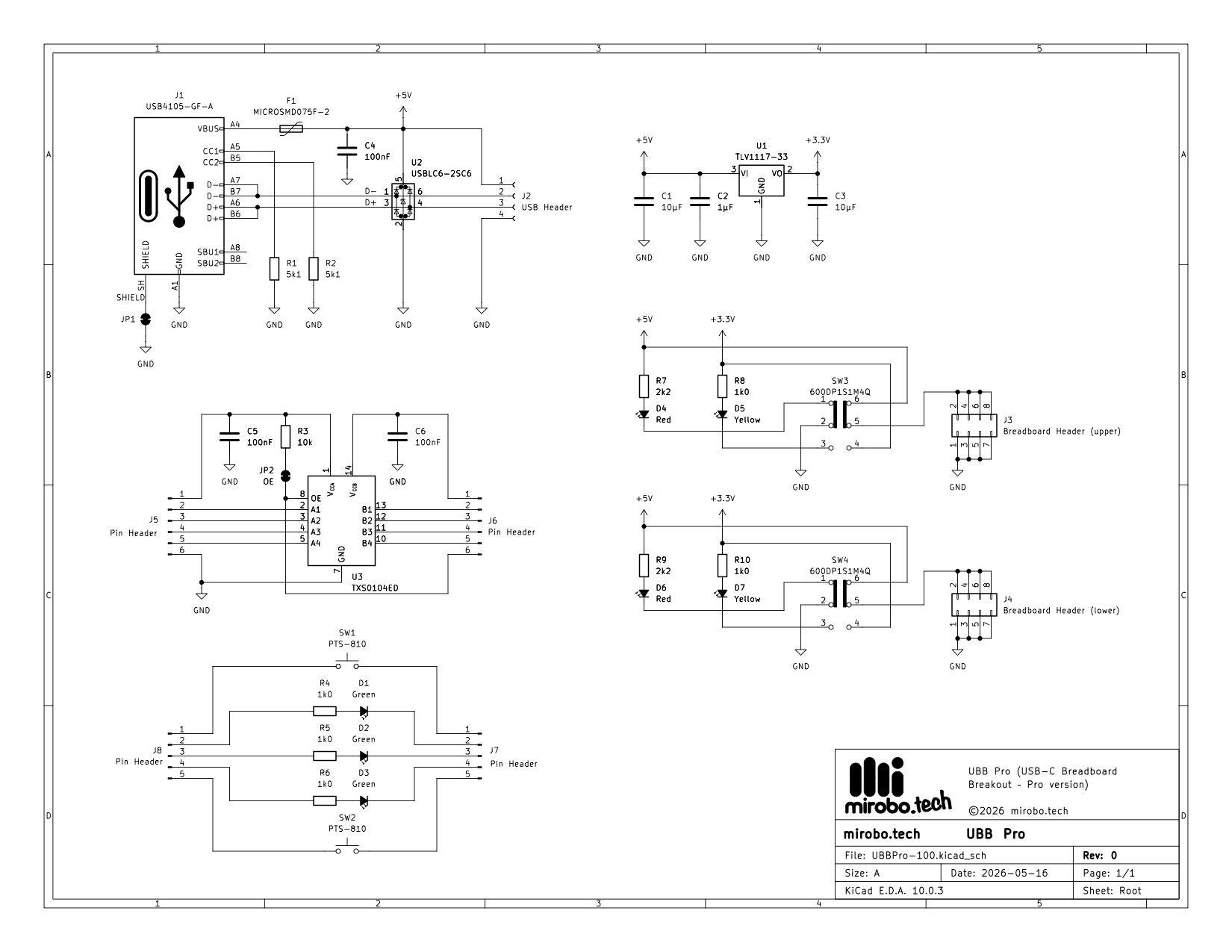
Forget the expensive power supply – UBB Basic and UBB Pro are designed to supply both rails of most common breadboards with either 3.3V or 5V from their USB-C inputs.
But, that’s not all! Both UBB Basic and UBB Pro come with two additional breadboard helper circuits. The first is an I/O circuit with two pushbuttons and three LEDs, and the second is a level shifter circuit to adapt up to four I/O pins on your breadboard devices between 3.3 and 5V.
UBB Pro even breaks out USB-C data signals so you can power and communicate with your USB-capable microcontroller with just one cable to your computer or laptop!
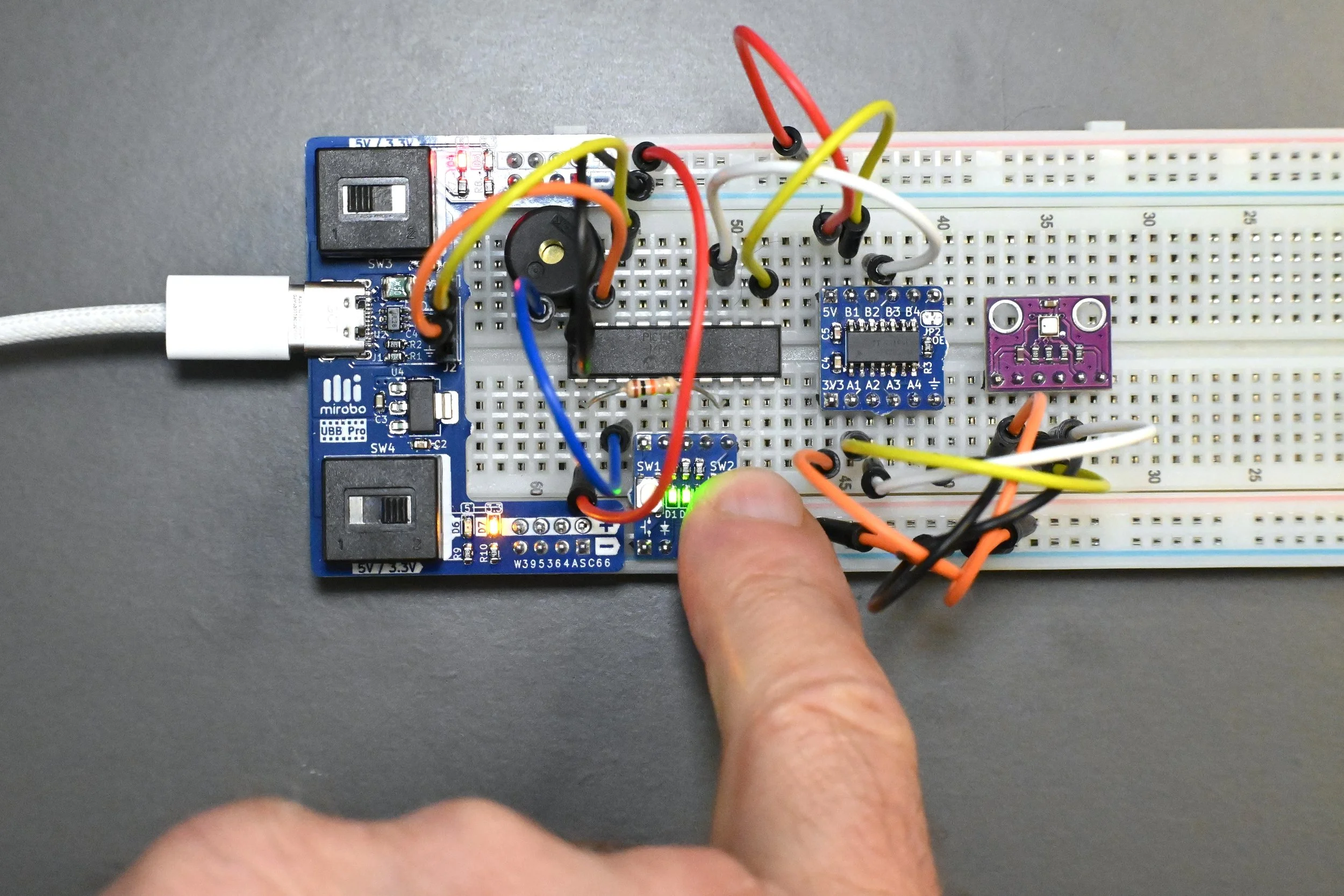
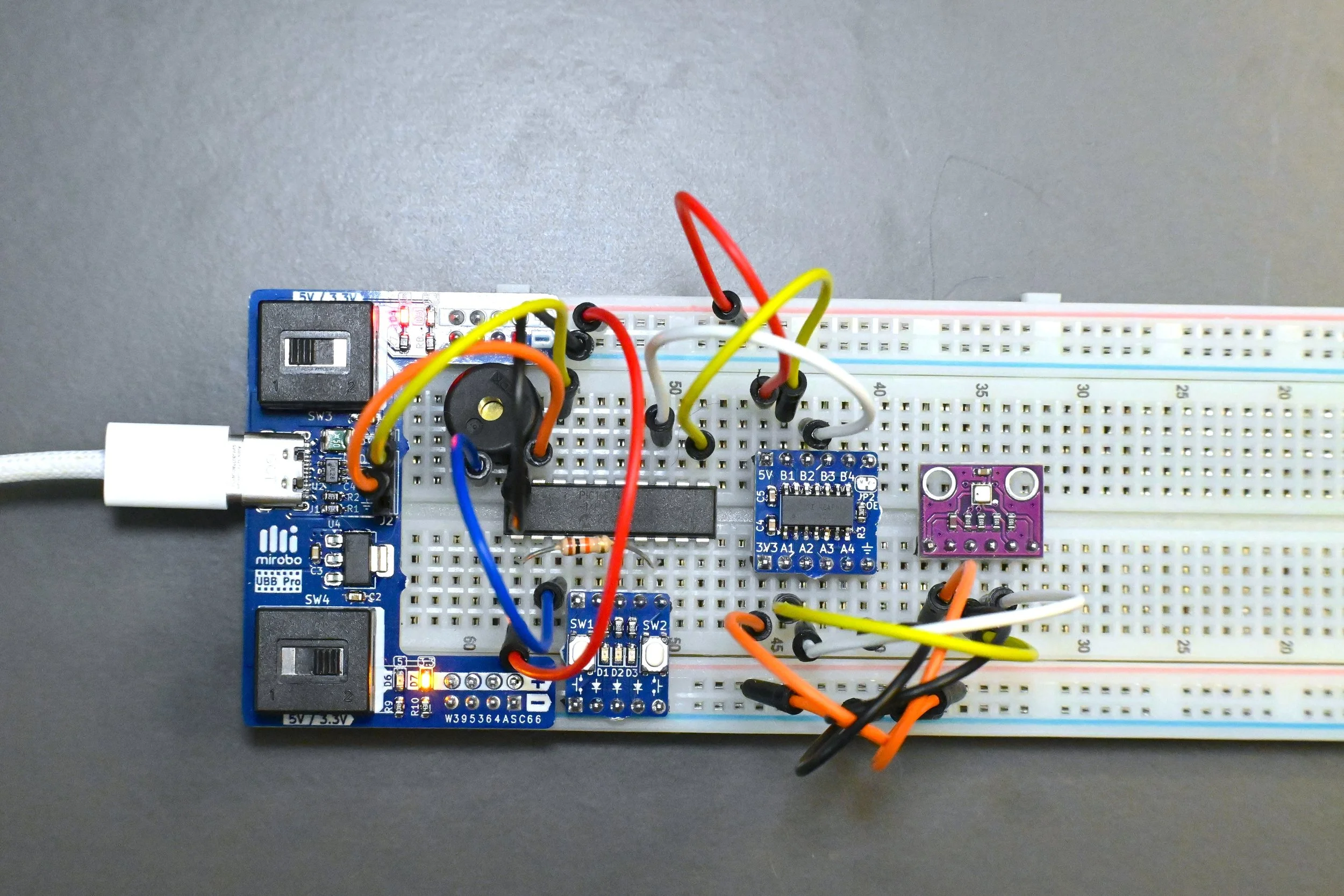
UBB Pro does it all! UBB Pro (left) powers and programs a 5V PIC microcontroller with on-board USB capability from 5V supplied by its top rail. At the same time UBB Pro also powers a purple environmental sensor from 3.3V supplied by its bottom rail. A finger presses a switch on UBB’s I/O board, which acts as an input to the microcontroller, while two LEDs on the same board indicate output states. UBB’s level shifter circuit safely connects the microcontroller’s 5V I2C bus to the 3.3V I/O on the sensor board.
UBB Basic or UBB Pro?
UBB Basic and UBB Pro both feature USB-C input, protected by a Polyswitch® resettable fuse, and provide both 5V and regulated 3.3V outputs to breadboard circuits.
Both provide either 5V and ground, or 3.3V and ground to each set of (top and bottom) breadboard rails, but the way they do it is different:
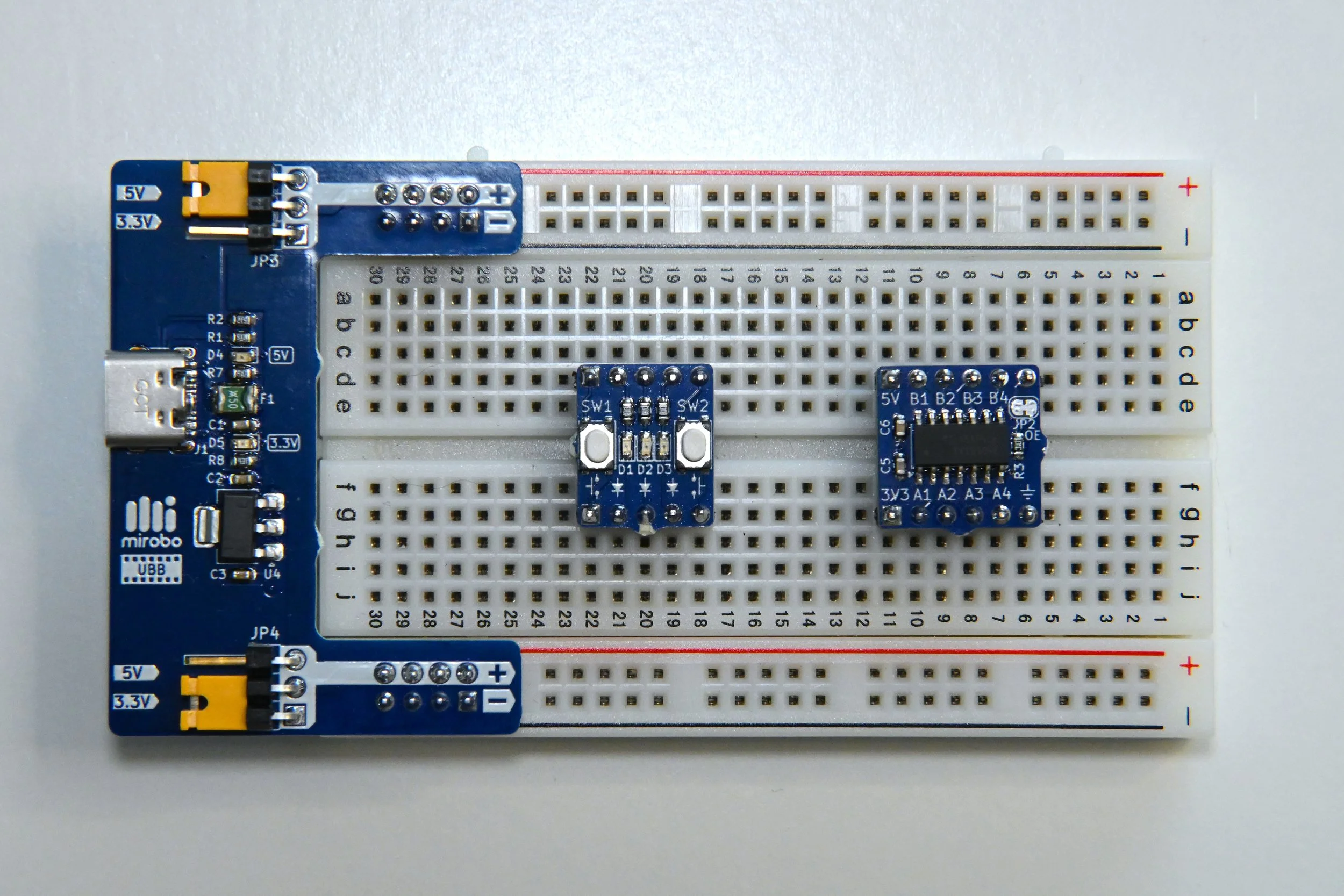
UBB Basic lets you select the individual rail voltages using two re-positionable jumper shunts.
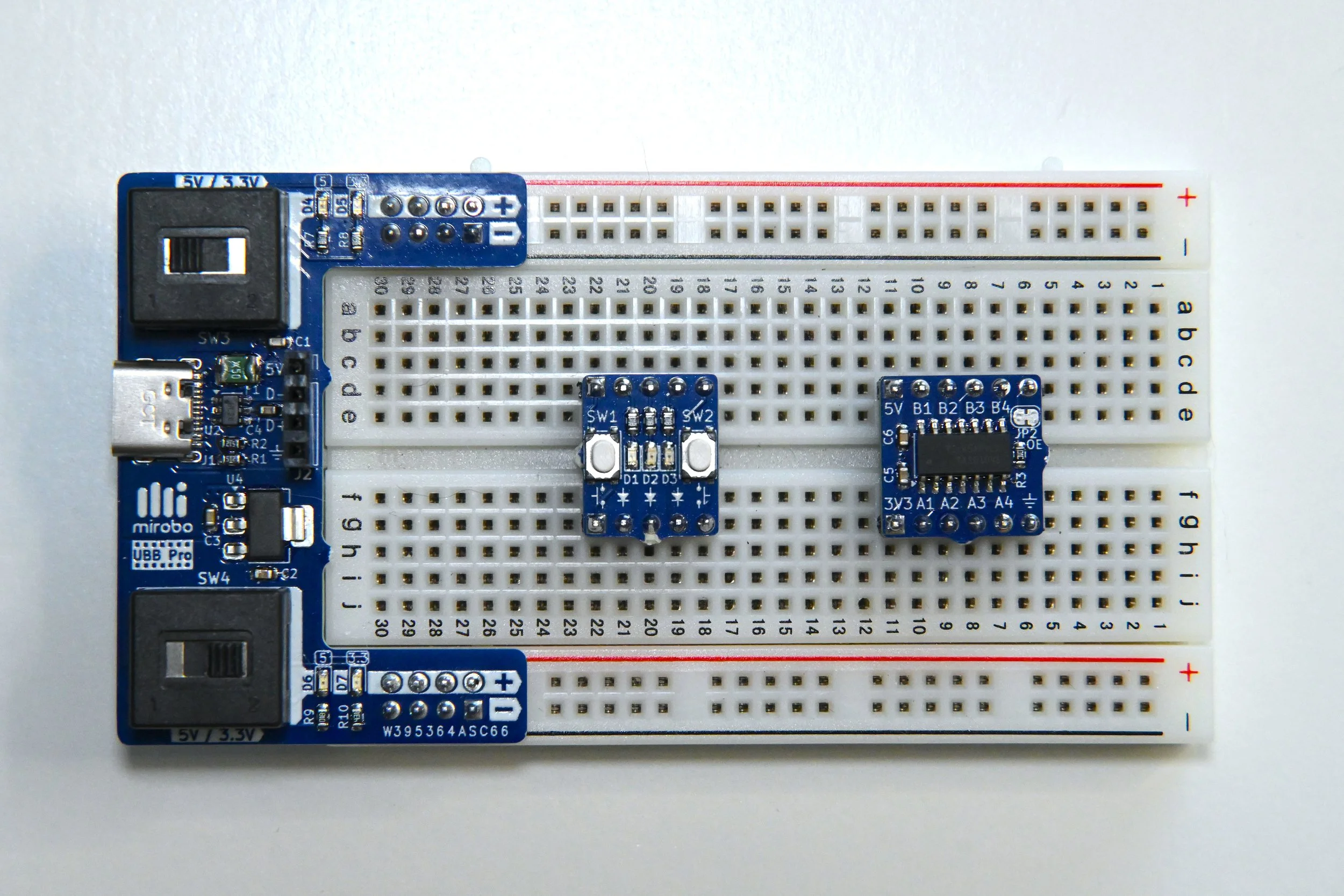
UBB Pro uses two switches, with safely recessed actuators, to select individual rail voltages. Each UBB Pro output rail also features colour- indicating output LEDs – red for 5V, and yellow for 3.3V.
USB-C Breakout
UBB Pro has an additional feature – it passes the USB data lines to your breadboard circuit through an ESD-protection diode array, to help prevent damage to sensitive microcontrollers. One USB-C cable lets you power, program, and debug your circuits!
UBB Basic
When you need a simple, compact USB-C breadboard power supply, UBB Basic has got you covered. Its right-angle jumpers make it easy to select each rail’s output voltage using jumper shunts – without getting snagged in your backpack or poking you the way vertical jumpers would.
It also comes with an I/O breakout board and a level translator board.
UBB Pro
UBB Pro uses slide switches with recessed actuators to simultaneously make it quick and easy to change output voltage, but difficult to change the voltage accidentally!
UBB Pro is the perfect companion for prototyping USB devices using your computer, since it passes the USB data lines through to their own header while powering your circuit. It also includes an I/O breakout board and a level translator board!
UBB Basic and UBB Pro Features:
Input: 5V USB-C, protected by a 1.5A Polyswitch® resettable PPTC device
Output: selectable 5V (supplied from USB) or 3.3V (supplied from USB through a TLV1117 extremely-low quiescent current regulator) outputs, connected to two sets of 2-row, 4-pin headers designed to fit into most breadboard power rails
Voltage indicators: separate 5V and 3.3V LEDs
4-pin USB header (UBB Pro only): VUSB (5V), D+, D-, and GND, with data line ESD protection (USBLC6 ESD diode array)
UBB I/O Prototyping Helper Board
Inputs: two momentary pushbuttons
Outputs: three green LEDs with current-limiting resistors
UBB Level Translator Board
4-bit, bi-directional level translator IC (TXS0104E), with Output Enable pin tied high (or controlled via an input pin through a cuttable jumper)
PORT A input/output voltage: 1.65V - 3.6V (Pins A1 - A4)
PORT B input/output voltage: 2.3V - 5.5V (Pins B1 - B4)